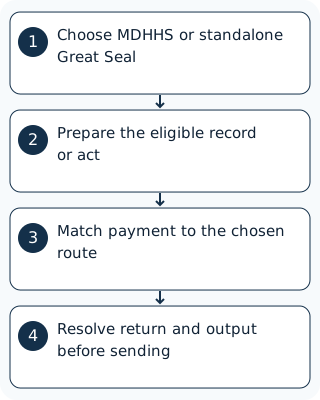
Begin with the record and the receiving office
Get the recipient’s written requirement: exact document, issuer, version, age, purpose, translation and paper or electronic delivery. Check the applicable Convention relationship, including entry into force, territorial coverage and objections. A country appearing in a list is not the whole test. An apostille authenticates origin, not the truth, accuracy or legal effect of the document. If a law or agreement dispenses with authentication, do not purchase an unnecessary certificate. [HCCH-01; HCCH-02; HCCH-03; HCCH-05; HCCH-06.]
HCCH-01 source
HCCH-02 source
HCCH-03 source
HCCH-05 source
HCCH-06 source
Use apostille or certificate of authority for the correct destination
Michigan applies the same fee and application requirements to apostilles and Certificates of Authority, but the destination determines the international route. For a Convention relationship covering the document, the apostille replaces diplomatic or consular legalization. For a destination outside that route, obtain the specific further authentication/legalization instructions before submitting. Neither Michigan product is intended for use within the United States; a foreign delivery address alone does not establish foreign use. [MI-03; MI-02; HCCH-01; HCCH-02.]
MI-03 source
MI-02 source
HCCH-01 source
HCCH-02 source
Identify the official signature or notarial act being authenticated
The state’s ordinary direct-signature routes include Michigan notaries, county clerks and designated deputies, the State Registrar, and city clerks/registrars only in Wayne, Oakland and Macomb counties. Specific LARA guidance adds eligible certified company outputs. A court clerk’s signature is not automatically on the same direct list. Ask whose signature will appear on the certificate before ordering. This avoids confusing a public office’s record with a private declaration about that record. [MI-03; MI-07.]
MI-03 source
MI-07 source
Check Michigan connection and published exclusions
The Prohibited Documents sheet excludes documents without Michigan affiliation or ties, out-of-state/country records, out-of-state notarizations, U.S. immigration/naturalization paperwork, domestic-use requests, and certain sovereignty/citizenship or unlawful-purpose documents. Treat this as Michigan’s published administrative screen, not a statement that all legitimate documents mentioning citizenship are void. For a legitimate unusual request, obtain an answer about the exact document, Michigan nexus and requested signature. A notary’s lawful ability to act and the state’s apostille eligibility screen are different questions. [MI-08; MI-11.]
MI-08 source
MI-11 source
Order an issuer-certified Michigan vital record
Use a certified copy from the State Registrar or eligible county clerk; city-clerk copies qualify only for the three named counties. The birth-record guidance rejects photocopies, notarized vital records, court/probate-clerk copies and out-of-state vital records. Its helpful tips say the certificate must have been produced within 15 years and stand alone without extra attachments. A century-old birth may therefore need a newly issued certified copy; the event’s age and certificate’s issue age are different facts. [MI-04.]
MI-04 source
Choose the combined state vital-record service when it fits
MDHHS provides apostilled/authenticated applications for birth, death, marriage and divorce records. These let you order the source record and authentication through an official handoff rather than procure a normal copy and automatically hire an intermediary. Specify the foreign country and purpose. Its service page distinguishes record verification, which may give only limited facts and no copy, from a certified certificate. An heirloom birth announcement is expressly unsuitable as a legal birth certificate. [MI-13; MI-14; MI-15; MI-16; MI-17.]
MI-13 source
MI-14 source
MI-15 source
MI-16 source
MI-17 source
Prepare birth-record eligibility and identity evidence
The birth application asks whether you are the subject, named parent, eligible heir, court-authorized person, guardian/custodial party or authorized attorney. It asks for relationship/legal evidence where applicable, adoption and name-change facts, foreign-use country and a hand-signed ink application. Its page 2 provides three identity tiers, including a U.S. or foreign passport in Tier 1 and defined alternative combinations. For a birth record at least 100 years old, the form provides a separate category with no ID required. Otherwise send copies of the requested ID, not original identity documents. Eligibility and proof of identity are separate from the eventual notary/apostille transaction. [MI-14.]
MI-14 source
Calculate the combined vital-record charge correctly
The inspected birth/death/marriage/divorce authenticated applications list a $42 base search including one certified copy or a no-find letter, $26 for each additional apostilled copy, $12 for each additional search year, and $25 extra for MDHHS rush handling. The current online fee table lists $42 for an apostille/exemplified record plus a $14 online processing fee. These charges are not the same as the $1 standalone Great Seal authentication. Follow the combined order’s total; do not add a separate $1 check unless its instructions require one. [MI-14; MI-15; MI-16; MI-17; MI-13; MI-02.]
MI-14 source
MI-15 source
MI-16 source
MI-17 source
MI-13 source
MI-02 source
Use the current vital-record queue rather than an old printed estimate
The MDHHS page checked October 24, 2026 warned of 12–16 weeks for regular authenticated/apostilled requests and 8–10 weeks expedited. The older inspected birth form instead describes 4–6 weeks at MDHHS plus 1–2 at Great Seal, or 2–3 plus 1–2 for rush. Those estimates conflict; the current queue notice is the safer planning evidence, not a guarantee. Do not add every number together or assume the old printed form’s shorter schedule remains available. All delivery and correction time remain consequential. [MI-13; MI-14.]
MI-13 source
MI-14 source
Keep combined-order return rules separate from Great Seal returns
For the MDHHS combined mailed service, the inspected applications direct payment by check or money order to State of Michigan and mail to Vital Records Requests, P.O. Box 30721, Lansing MI 48909; use Vital Records RUSH for rush requests. They state results return by USPS First Class Mail and prepaid envelopes will not be accepted. This differs from the standalone Great Seal form, which asks for your return envelope or prepaid airbill. Do not transplant one office’s return instructions onto the other office’s order. [MI-14; MI-15; MI-16; MI-17; MI-02.]
MI-14 source
MI-15 source
MI-16 source
MI-17 source
MI-02 source
Compare a county certificate, appointment or Will Call carefully
MDHHS also offers appointment ordering and VitalChek Will Call, with Tuesday/Thursday, 10 am–2 pm pickup and a stated 2–5 business-day Will Call process after notice. Its page does not establish that this short pickup promise includes completed apostille handling. A locally issued eligible certified certificate plus a separate scheduled authentication visit may address a real deadline, but confirm both outputs and appointments first. A fast source certificate alone is not a completed apostille. County fees and availability differ from the state combined service. [MI-13; MI-01; MI-04.]
MI-13 source
MI-01 source
MI-04 source
Distinguish a divorce certificate from the court judgment
MDHHS’s divorce record is a vital-record product; the actual judgment or order is a court document. Ask the recipient whether it needs proof of the divorce event, the final decree, terms, name-change order or another filing. The state offers a combined authenticated divorce-record application, but that does not establish that it contains every page or term of the judgment. Obtain the exact court copy from its custodian when that is what the recipient requests. [MI-13; MI-17; MI-05.]
MI-13 source
MI-17 source
MI-05 source
Follow the specific court-document procedure rather than guessing
The court PDF first rejects court/probate-clerk signatures for direct authentication, then explains a separate route: the person named in or producing the court document signs a true-copy statement before a Michigan notary. The statement may be on the document or an attached sheet; the named person is making it, not the notary. The PDF supplies limited minor/deceased-person exceptions. Use a genuine eligible declarant and accurate statement, and obtain the recipient’s acceptance of this different notarial-origin route before relying on it instead of a direct court certification. [MI-05; MI-10; HCCH-03.]
MI-05 source
MI-10 source
HCCH-03 source
Understand the court FAQ tension and what resolves it
The FAQ says court-clerk documents are not acceptable, while another answer says such documents may be authenticated if notarized. The court PDF explains why those sentences need not mean the same signature: direct certification of the clerk is distinct from authentication of a notary who took a holder’s declaration. This is an analytical reconciliation, not written approval of your record. Ask Great Seal whether your particular county-clerk-issued certification qualifies directly or the precise holder-declaration package is required. Do not pretend the state authenticates the court seal when the apostille identifies a notary. [MI-03; MI-05; HCCH-03.]
MI-03 source
MI-05 source
HCCH-03 source
Prepare school records through the school when possible
The state school guidance permits a true-copy/original statement by the school official, the named student, or a parent/guardian for a dependent student under 18. The notary cannot certify the copy. When the records are not yours and the named student is outside Michigan, the guidance directs a school official to state true-copy status and title, sign with an original signature and have that signature notarized. A registrar-prepared package is often the strongest match when a recipient wants the school to verify the academic record itself. [MI-09.]
MI-09 source
Protect an original diploma and choose the right issuer service
Michigan’s school guidance warns authentication is permanently affixed to the original, so consider whether an accepted certified/declared copy is preferable. The University of Michigan provides notarized transcripts but says it will not send them directly to Great Seal; you handle the state submission after receiving the notarized transcript. Its registrar language says apostille certifies documents are true; the Convention’s narrower rule is authentication of origin. An emailed transcript or eDiploma is not automatically the notarized paper package the state will accept. [MI-09; MI-22; HCCH-03; HCCH-06.]
MI-09 source
MI-22 source
HCCH-03 source
HCCH-06 source
Order current LARA certificates and copies through the issuer
Michigan company records come from LARA, not the Secretary of State’s corporate office. Its current page directs requests to the MiBusiness Registry Portal launched June 23, 2025. For good standing, its October 7, 2026 FAQ says to log in with MiLogin for Business, locate the entity, select Request Certificate, complete the good-standing request and pay by debit/credit card. The certificate is sent to the email on that account. A good-standing certificate and certified Articles are different products; choose what the recipient needs. [MI-18; MI-19.]
MI-18 source
MI-19 source
Recognize an eligible certified LARA output
The specific Great Seal LARA PDF accepts paid certified records and rejects free website printouts. It shows new Articles of Organization and good-standing examples, with black LARA seal and certificate number/verification label. The displayed 10502 is an example number, not a number every certificate must share. It says LARA records should not be notarized and each is a separate document. Preserve the issuer’s original electronic file and certification. If the new portal’s output differs from the published sample, resolve that exact format rather than add a notarial stamp to a free search image. [MI-07; MI-18.]
MI-07 source
MI-18 source
Separate company-copy fees from authentication fees
The inspected issuer fee table lists corporate/LLC good standing at $10 ordinary or $12.50 expedited. Certified copies cost at least $16 for the first six pages plus $1 each additional page; expedited copies start at $20 with $1.25 per extra page. Expedited issuer work is distinct from Great Seal authentication, which is $1 per submitted document and has no paid expedite. The current portal’s calculated total and selected certificate/copy should be checked before payment, especially for multiple filings or a certificate of fact. [MI-20; MI-02.]
MI-20 source
MI-02 source
Keep private company declarations and official records distinct
An operating agreement, authorization, resolution or power of attorney is not necessarily a LARA-issued record. It can require a private signer’s appropriate notarial act. Confirm the signer’s capacity, actual Michigan connection and recipient-required wording before signing; do not rewrite an issuer certificate as a private statement to disguise its origin. One company packet may contain several documents authenticated through different signatures. Paid help adds value only if it solves preparation, procurement or coordination that the official route does not already solve. [MI-08; MI-11; MI-07.]
MI-08 source
MI-11 source
MI-07 source
Choose the right background check before paying
A Michigan state fingerprint response, ICHAT name search, local police certificate and FBI national record answer different questions. Great Seal’s background guidance lists several sources, but the recipient decides the actual coverage required. For a Michigan fingerprint-based personal/visa/adoption response, MSP’s procedure is a useful direct route: it supplies an original certified/notarized response, avoiding the assumption that you must obtain an ordinary screen and then invent a private certification. [MI-06; MI-21.]
MI-06 source
MI-21 source
Request a Michigan fingerprint response in the prescribed form
MSP directs Michigan residents to a Michigan Applicant Fingerprint Card RI-008; nonresidents needing a Michigan check use FD-258 and state the purpose. Include a cover letter with the reason, return address and contact details, plus a $30 check or money order to State of Michigan. Mail to Michigan State Police, CJIC, P.O. Box 30266, Lansing MI 48909-7766. One original certified/notarized response is included; additional originals are $1 each. MSP sends results only to the fingerprinted individual, not your intermediary, and estimates 3–5 weeks for processing/mail. [MI-21.]
MI-21 source
Treat an ICHAT printout or federal record with category precision
Great Seal’s background PDF describes an agency-notarized response or a named person’s notarized true-copy declaration when an agency has not notarized it. It also lists FBI records, while other state guidance excludes out-of-state/federal-type records and the federal system has its own authentication authority. Do not infer that a Michigan apostille authenticates the FBI’s signature merely because a person signs a copy statement. For an FBI record itself, use the federal competent-authority route; any proposed separate private declaration needs its own recipient acceptance and Michigan eligibility. [MI-06; MI-08; HCCH-01; HCCH-03; HCCH-11.]
MI-06 source
MI-08 source
HCCH-01 source
HCCH-03 source
HCCH-11 source
Have the right person make a copy statement
Michigan notaries cannot certify a document as an original or true copy. The state’s general statement guidance identifies the person named in or producing the record, calls for proof of relationship and gives limited parent/deceased-person exceptions. Its samples do not authorize any intermediary to call itself the custodian of every record. A notarized statement authenticates the declarant’s signature/act, not the issuer’s original signature or the factual accuracy of the copy. Some recipients insist on issuer certification despite state processing of a declaration. [MI-10; MI-11; HCCH-03.]
MI-10 source
MI-11 source
HCCH-03 source
Complete a real notarial certificate and the correct act
Determine the acknowledgment, oath/jurat or signature-witnessing act required before notarization. Michigan’s manual distinguishes acknowledgment of an existing signature from an oath or signature witness that requires signing in the notary’s presence. Include the commissioned name and signature, date, commission county and expiration, and acting county when different. Use readable/reproducible elements and an English notarial certificate for authentication. The state does not provide notary service; a bank, credit union or local notary may be enough once the act and wording are settled. [MI-11; MI-03.]
MI-11 source
MI-03 source
Keep electronic notarization and remote notarization separate from e-Apostille
Michigan allows approved electronic and remote systems. The March 2026 standards impose approved-platform and identity/credential-analysis requirements; being a convenient video app is insufficient. An electronic original and its signatures must remain verifiable. Great Seal says it does not perform authentication online, but that statement alone neither bans all electronic-source records nor proves a true e-Apostille issuance service. No current universal public paper-conversion instruction was established here. Before arranging a new electronic act, settle the exact file, print certification, submission and final apostille format with Great Seal and the recipient. [MI-11; MI-12; MI-01; HCCH-10.]
MI-11 source
MI-12 source
MI-01 source
HCCH-10 source
Use English translation for Michigan processing and recipient rules separately
The current Great Seal service page/form require a written English translation for foreign-language documents; school and true-copy sheets additionally say notarized English translation. Identify the document category and follow its specific instruction, resolving an uncertain translation certification before filing. This is separate from the destination’s demand for translation into another language or use of a locally sworn translator. An apostille on a translator’s declaration does not make the underlying record or translation substantively correct. [MI-01; MI-02; MI-09; MI-10; HCCH-09.]
MI-01 source
MI-02 source
MI-09 source
MI-10 source
HCCH-09 source
Complete the Great Seal request and count authentications
The one-page form asks for the requestor’s name/phone/email, return addressee and address, number of documents and foreign country of use. It separately distinguishes Mainland China, Hong Kong and Macao. Pay $1 per authentication, not per page, by check or money order payable to State of Michigan for mail submission. Keep source procurement, notary, optional assistance and transport costs separate. A document bundle with several independently authenticated records is not automatically a single $1 request. [MI-02.]
MI-02 source
Use the proper mailing destination and prepaid return
Mail the standalone application, eligible documents, fee and return envelope to Michigan Department of State, Office of the Great Seal, 7064 Crowner Drive, Lansing MI 48918. The FAQ instead says Crowner Boulevard and a longer ZIP; this guide follows the current service page and linked form rather than silently mixing addresses. The form permits stamped return or prepaid airbill and requires you to be both sender and receiver on a courier return label. The FAQ also asks for the account number; Great Seal will not pay the postage. [MI-01; MI-02; MI-03.]
MI-01 source
MI-02 source
MI-03 source
Choose a scheduled office visit instead of assuming walk-in service
Current public instructions require an appointment. The Great Seal notice offers Monday/Wednesday, 8:30 am–4 pm; its visit location is Richard H. Austin Building, first floor, 430 W. Allegan Street, Lansing. Other listed authentication offices are Clinton Township, Detroit–West Grand Boulevard, Flint–Fenton Road, Grand Rapids–28th Street, Lansing–East Michigan Avenue, Livonia, Marquette and Pontiac. Check the appointment system for the actual authentication transaction/location. Online scheduling is not online authentication, and neither an arbitrary branch nor a self-service kiosk performs this service. [MI-01; MI-03.]
MI-01 source
MI-03 source
Distinguish postage speed from state processing speed
The linked August 2023 form says allow 4–6 weeks after office receipt and no expedited service; the FAQ still says 1–2 weeks. Both also describe processing in receipt order and no faster processing for express/courier mail. The discrepancy prevents a reliable current shorter guarantee. Use the form’s longer allowance for planning unless the office gives current written information for the chosen channel. Faster transport can save transit days; it does not purchase a place ahead of the mail queue. [MI-02; MI-03.]
MI-02 source
MI-03 source
Decide whether direct, local or managed handling solves the actual problem
Direct official mail is sensible when preparation is clear and the published timing fits. A scheduled local visit may remove mail legs; add appointment availability, travel and correction risk before judging it faster. A local helper can attend or retrieve only within the service’s actual rules; no privileged queue is established. Managed help may add record ordering, certificate review, a correction owner or international coordination. Compare those benefits with the total price and handoffs. Do not hire an intermediary merely because the issuing state is far away. [MI-01; MI-02; MI-13; MI-19.]
MI-01 source
MI-02 source
MI-13 source
MI-19 source
Inspect and verify the finished authentication
Check the certificate’s official/notary name and capacity, seal, date and number against the attached document. Keep the attachment intact. Convention Article 7 supplies a register-check route with the issuing authority; this review did not establish a Michigan online apostille e-register. Send the exact certificate particulars to Great Seal when verification is required. LARA’s company-certificate verification checks a different product. A scan is useful for review but does not replace the paper packet or preserve all verification properties of an electronic original. [HCCH-04; HCCH-07; MI-07; MI-02.]
HCCH-04 source
HCCH-07 source
MI-07 source
MI-02 source
Recover from a returned request by fixing the named defect
Keep the written return reason and identify whether it concerns an ineligible source, missing original/certification, wrong declarant, payment, translation, return label or incomplete notarial act. The state’s sheets direct notarial corrections to the original notary, with changes initialed, and say notaries cannot charge to correct their notarization. Do not alter an issuer record or add stamps yourself. If the underlying certificate is wrong or too old, obtain a replacement from its issuer. Establish any resubmission/new-fee instruction for the actual return; no universal state refund or rework waiver was established. [MI-05; MI-10; MI-04; MI-02.]
MI-05 source
MI-10 source
MI-04 source
MI-02 source
Correct a background record at the source before authentication
MSP routes erroneous arrest information to the arresting agency, charge information to the prosecutor and court information to the reporting court. Apostille cannot repair those entries. Preserve the disputed report, obtain the appropriate reporting-agency correction and request the correct replacement/certified response before authentication. A recipient’s rejection for substantive record content is different from a faulty authentication certificate; preserve exactly who rejected it and why. [MI-21; HCCH-06; HCCH-08.]
MI-21 source
HCCH-06 source
HCCH-08 source
Worked example: one birth record and a realistic deadline
A recipient needs a newly issued Michigan birth certificate with apostille. The official combined MDHHS request can solve procurement and authentication without an outside runner, with eligibility/ID evidence and its $42 base search. But the checked combined queue is 12–16 weeks regular or 8–10 expedited. If that misses the deadline, investigate an eligible county-issued certificate plus a scheduled authentication appointment; obtain the recipient’s format acceptance and both offices’ actual availability before changing routes. Neither a short Will Call notice nor expensive postage proves completion in time. [MI-13; MI-14; MI-04; MI-01.]
MI-13 source
MI-14 source
MI-04 source
MI-01 source
Worked example: company certificate and privately signed authorization
A recipient asks for LARA good standing and a separately signed authorization. Order the actual paid company certificate in the current issuer system and preserve its certification; do not notarize a free database printout. Have the authorized signer complete the separate private notarial act if required and Michigan-eligible. If each needs one authentication, the Great Seal portion is $2, while issuer procurement, notarization and delivery are additional. A single packet does not erase the two different signatures or make either certificate prove the other document’s claims. [MI-07; MI-19; MI-20; MI-08; MI-11; MI-02.]
MI-07 source
MI-19 source
MI-20 source
MI-08 source
MI-11 source
MI-02 source